

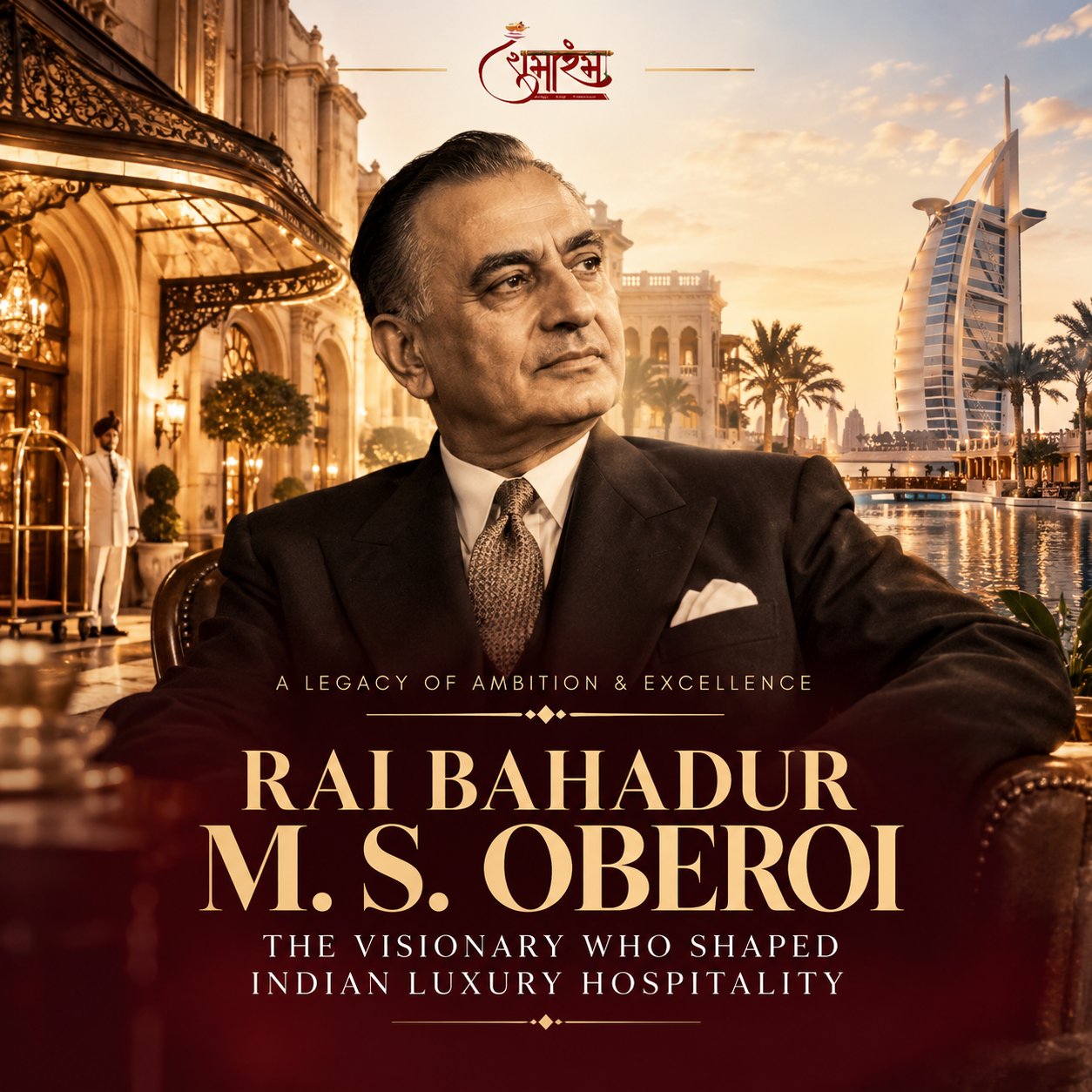
From an early hotel job in Shimla to building an internationally recognised hospitality group, Rai Bahadur Mohan Singh Oberoi’s journey offers lessons in service, ambition and long-term thinking for today’s hotel developers.
Early life and the first step into hospitality
Rai Bahadur Mohan Singh Oberoi was born on 15 August 1898 in undivided Punjab, in a region that is now part of Pakistan. After losing his father in infancy, he grew up facing significant challenges. He later moved to Shimla and began his hotel career at the Cecil Hotel, where he learned the discipline and detail behind guest service.
His early work was not limited to the tasks written in a job description. He observed how hotels operated, learned from experienced managers and took on additional responsibilities. That habit of learning from the ground up became a defining part of his professional journey.
From hotel employee to entrepreneur
In 1934, Oberoi acquired Clarkes Hotel in Shimla by committing his assets and mortgaging his wife’s jewellery. The decision represented a substantial personal risk, but it also gave him direct responsibility for the guest experience, operations and commercial performance of a hotel.
He later took over the operations of the Grand Hotel in Calcutta, turning a difficult business situation into a stronger operation. These milestones illustrate a practical lesson for hospitality entrepreneurs: a compelling vision needs to be supported by operating discipline, financial judgement and close attention to guests.
Building a hospitality group with a long view
Oberoi went on to acquire a controlling interest in Associated Hotels of India in 1943. In the decades that followed, the group expanded its portfolio and helped introduce new expectations for luxury hospitality in India. The Oberoi Inter-Continental in New Delhi opened in 1965, and the Oberoi Sheraton in Bombay followed in 1973.
His legacy was not only about buildings. It also included training, service systems, careful restoration of heritage properties and attention to the details that shape a guest’s memory of a hotel.
What hotel developers can learn from his journey
First, guest experience should inform design decisions from the beginning. Arrival sequences, reception visibility, room privacy, acoustics, lighting, housekeeping routes and back-of-house circulation all affect the quality of a stay.
Second, consistency depends on execution. A luxury concept must be translated into coordinated architecture, structural and MEP engineering, interior detailing, procurement, construction quality checks and commissioning.
Third, long-term value comes from choosing materials and systems for their context. Facade finishes, decorative elements and bespoke features must balance visual character with durability, maintenance access, climate exposure and lifecycle cost.
Connecting hospitality vision with modern construction
Today, hotel owners in India and the UAE often balance brand identity, construction schedules, operating efficiency and ambitious design expectations. Materials such as glass-reinforced concrete (GRC) and fibre-reinforced plastic (FRP) can support selected facade, ceiling, decorative and themed applications when they are specified for the right use and installed to a documented design.
For developers, the practical takeaway is to connect the design brief to manufacturing tolerances, sample approvals, structural fixing details, fire and code requirements, installation sequencing and maintenance planning before production begins.
Conclusion
Rai Bahadur M. S. Oberoi’s story is a reminder that enduring hospitality brands are built through ambition paired with discipline, a clear service philosophy and attention to execution. For modern hotel projects, that same combination of guest-centred planning, sound engineering and consistent craftsmanship helps turn a building into a lasting destination.